
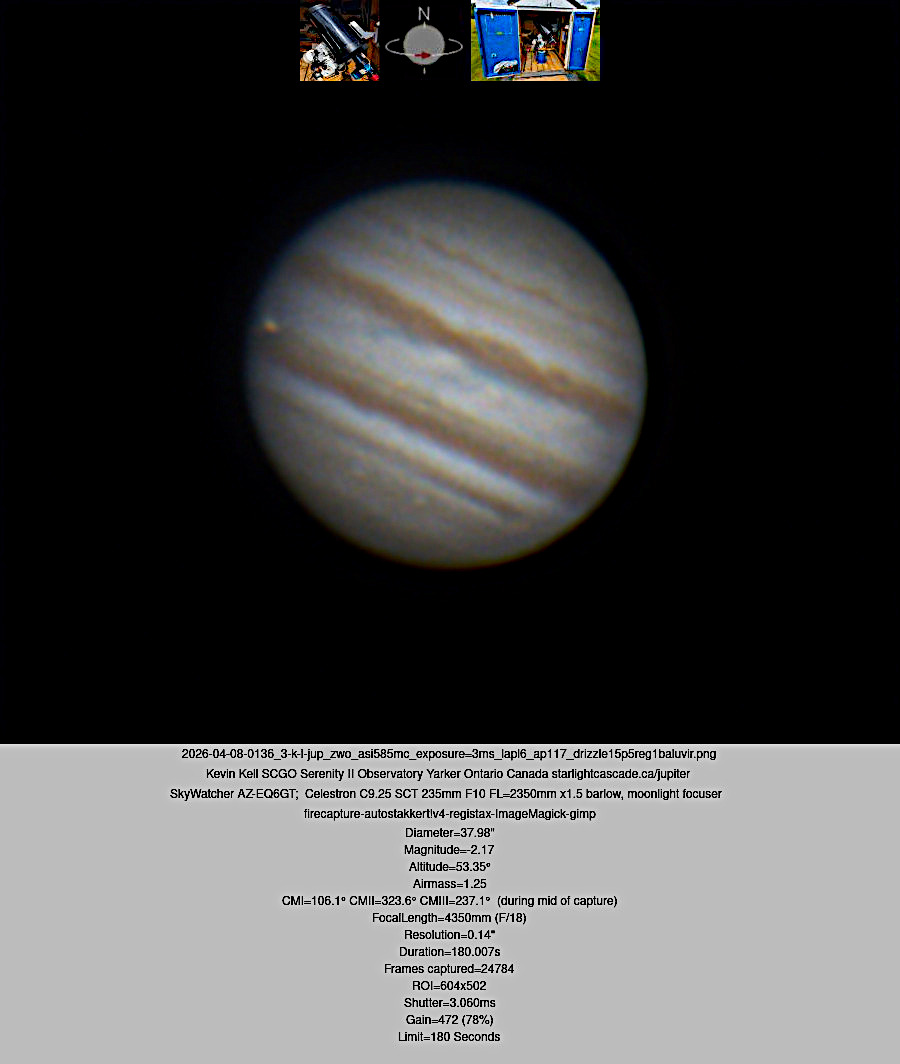
A nice clear sky greeted us Tuesday evening after a dumping of white cold feathers the previous 24 hours.
Seeing was a little better than average (6/10) but then went down to average (5/10) and transparency was also relatively good: average (5/10). Planning ahead a little I used Curt Nason’s (RASC NB) chart with Jupiter event info:
https://sjastronomy.ca/wp-content/uploads/2026/04/SJAC-2604.pdf
to discover that Io was going to transit as well as its shadow. I could only stay up late enough for the moon transit, not the moon shadow.
Jupiter was imaged 21 times, each a 3 minute imaging run and then a 2 minute break. I was using an exposure of 3ms and autogain to achieve a histogram of around 95% of peak exposure. About 1/2 way through the runs, I lost connection with my focuser again (2nd time now) and called it a night after Jupiter started at 61 degrees altitude (nice!) to 48 deg. A region of Interest of 800×800 pixels and a cutout box of 600×500 pixels was used. This is the best 5% of 25K frames taken. Jupiter continues to get further away, now with an apparent diameter of just under 38 arcseconds.
You can see the moon Io transitting Jupiter on its left side, near the equator. You can also see some anticylonic storms in the south (little white storms) A7 and A5. The storm BA can just be made out on the same latitude rotating off the right hand side. A UV/IR cut filter is also used in the imaging train.
Lastly is the animated video of 20 runs across approx 95 minutes.