![]()
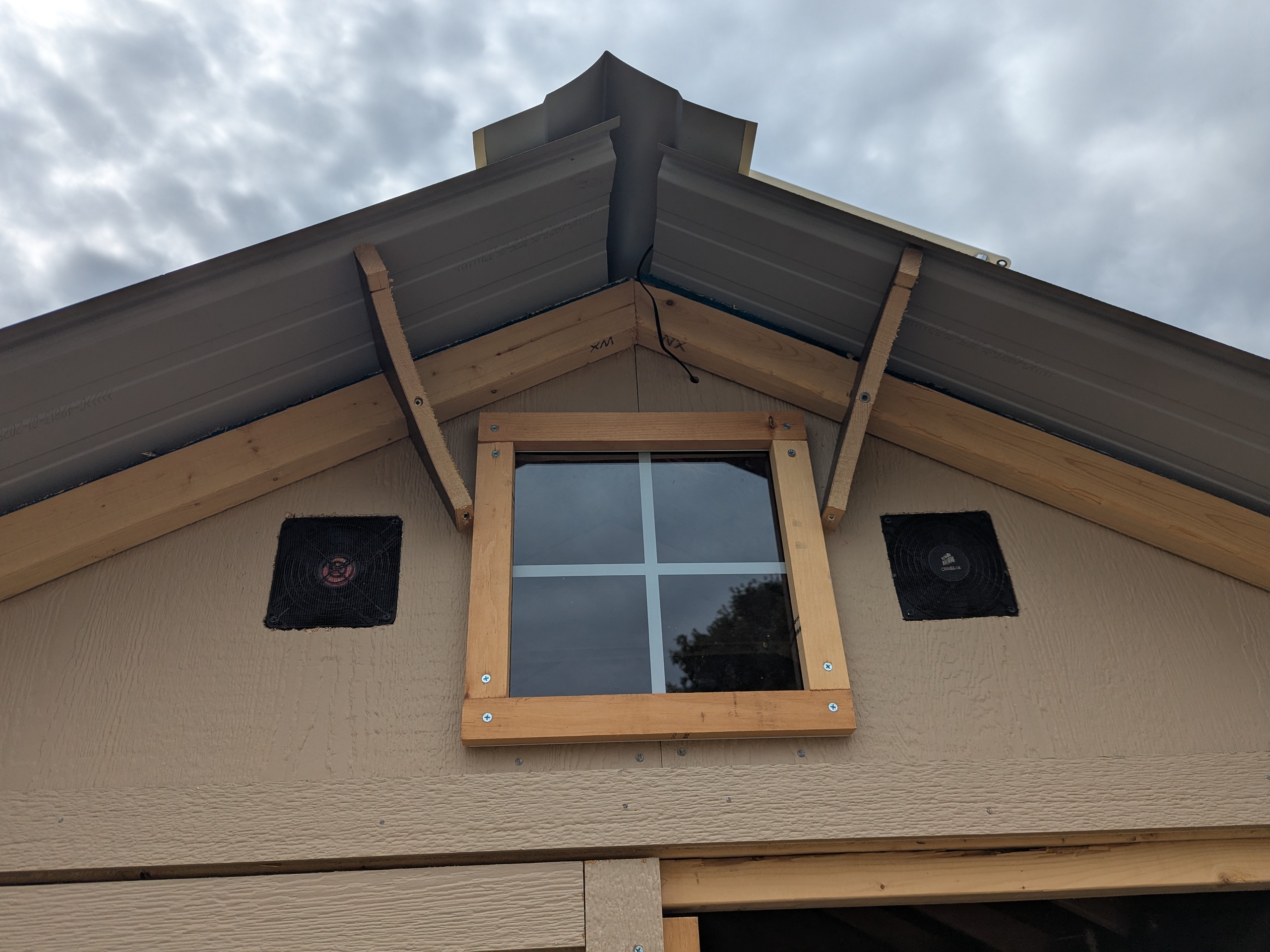
Sheds with a metal roof tend to be cooler than one with shingles.. but still sometimes too warm. So we added two 4″ fans powered by a small 30w solar panel on the roof.
The fans had metal grills and we added nylon insect netting to keep all sized of critters out.
Archive for alternative power
astro power

For those following the tales of portable power and our adventures at Starfest… the news is great!
We used a 32AmpHour 12vdc battery in the popup trailer to runs its lights, CO detector and other minor bits without issue.
We built a stand angled for approx early August solar declination/altitude for the 10watt solar panel to charge it. This was with spare 1×2’s and a spare 2×2 and a couple of bolts and nuts. It folds down to a compact shape as well. I think the solar panel is an old (10 year) 10watt from Canadian Tire?

We used the 6.5AH (Talentcell 12V LiFePO4 Battery Pack LF4100, 2000 Cycles Rechargeable 12.8V 6.5Ah 83.2Wh Lithium Iron Phosphate Battery with DC 12/9 Volt and 5V USB Output $70) to run the DSLR camera lens heater and to charge up the android tablet running the SeeStar S50 telescope and two smartphones for the three days. It was pretty much depleted by event end. We figured we could recharge it from the 32AH trailer battery if need be.

The 3rd system was a 12vdc 7AH power source in a princess auto ammo box powering the RASCKC Douglas 25cm dobsonian telrad heater and eyepiece heater.
It has a power hub but no limiting controls on it.. so the eyepiece was hot and the telrad was clear! We plan on doing some upgrades to the Douglas including variable power control for the accessories.
There were a *lot* of solar panels in the field!

Starfest also had 110vac charging stations here and there in buildings/tents for use if you did not purchase the field power option.
Observatory Power
Some questions came up locally about power, quality of power and their affect on astronomy equipment.
Have you considered a whole house surge protector on your main panel?
I think it would be $300-400 $Can but may require a spare/empty circuit breaker location.
Power to our observatory starts at the back deck on a GFCI (Ground Fault Circuit Interruptor) jack, then a buried 50′ 16gauge extension cord to the observatory.
Then a UPS to help bring up the voltage if need be (it would charge up the UPS battery during low demand and discharge the battery and bump up brownout/low voltage during higher demand).
The rest of the observatory is powered through that (LED lights, white lights, telescopes, laptop, 12vdc battery charger, netbook and supersid radio telescope).
Then *another* 50′ extension cord (16 gauge?) out to the tardis observatory, where another UPS is there to support.
That runs the torus telescope, torus computer, LED lighting red and white, imaging laptop).
From there *another 50′ extension cord runs out to the Serenity observatory. No UPS there.. we ran out of them.
It runs a laptop, the radiojove radio telescope and the telescope mount.
When we build *another* larger observatory out in the back, I think it will be about time to dig up the 16 gauge power cables and replace them with heavier 14 gauge or 12 gauge ones.
So.. get a UPS with a small battery -maybe 7AH at least) (you are not using it for long term power but rather filtering and support (brownouts and low voltage) when needed. You also get a software package that lets you log power events (serious ones, not minor noise), but in general there are RFI filters in the UPS as well.
One of the units is an APC BackUPS Pro 1000 which has gigabit rated network surge proection jacks, 4 surge jacks, 4 UPS Battery Backup jacks. Non critical equipment is plugged into the surge-only jacks (ie the 12vdc battery charger, etc).

The UPS is to be able to let you:
1) see when the power/lights go out
2) save your computer from a sudden crash (most of our laptops are old and the laptop batteries are no good anymore)
3) allow you to park your scope and shutdown your computer.
The biggest use of all is surge protection, brownout protection and RFI filtering.
* please note that items are secured and locked, video surveillance is onsite along with some active deterrence measures as well *
Pi backup

MFLASH 5000mAh Rubberized Power Bank – has been added to a raspberry pi as an uninterruptible power supply (UPS). It was on a Black Friday sale for $10, down from $25 and is connected to the Pi that died during our last power events (off, on, off, off, on). The Pi operating system had to be reinstalled from scratch and it would have been fine if the power had not cycled like it did.
It looks like it can simultaneous be charged from the pi power supply and power the pi through its 2.1 amps out port. Both connections are microUSB.
Update:
Two weeks later the battery is showing a full charge and the Pi has run continuously without issue.
Several months later.. still working without issue. Truly format and forget.
LED lighting
Another major light fixture has bitten the dust. Our kitchen light fixture had 3x60watt incandescent bulbs. It was really never enough light for the kitchen and so when we came across an LED fixture at Lowes last week, we bought it.
We are replacing 180 watts (about 2400 lumens) of incandescent with 57 watts (about 4200 lumens) of LED in a 42″ long fixture. The longer length helps eliminate and soften shadows on the counters. The fixture is centrally located in the ceiling and the old one was more point source and caused more shadowing than the new one.
At $160 before taxes, an estimated 2 hours/day use, and an estimated $.20 kwh, we estimate it will pay for itself in 8 years, more if we use the lights more than 2 hours/day. That’s about a 12% return on investment.
We had already replaced the old dimmer switch with an LED compatible one.

Not only does it use less power, but we now have maximum light levels that are a lot more useful. The minimum light level with the LED dimmer is only about 15-25% of max, making it bright enough to see but not blind at night. In addition, the colour temperature of the light is much whiter than the older lighting, better in the kitchen for judging the colour of food.

We’ve tried various kitchen undercounter lighting systems in the past… first were fluorescent, the compact fluroscent.. both took too long to turn on, to come up to full brightness, and full brightness was not great. Finding replacement bulbs was difficult as well.
Then along came the first LED fixtures. A little nicer, used less power, but not very bright. We had two chained together.
This is the latest and greatest. Bright white LED strip lighting, 16′ long which enabled us to make two passes under the counters. Pretty much lifetime lifespan of 50k hours, and only about 20 watts. Too bad the manufacturer did not list the lumen output… but it is bright. The brightest of all of the ones we have ever used.
We are now looking for the main kitchen light fixture replacement, in an LED fixture. Home Depot has some nice Hampton Bay designs, and sometimes they even list important information!
3010 lumens using 43 watts with a 50K hour lifespan at 4000K colour level (a little warmer than 5000 K lighting). Now if we can only find out if they are ableto work with a PWM dimmer switch.
Even more conservation

Our electricity rates in Ontario I believe are the highest in Canada.
We use time of day with 8.3; 12.8 and 17.5 cents/kwh at offpeak, midpeak and onpeak demand.
The problem is, that is only 50% of the price.. delivery and other charges double that to
16.6, 25.6 and 35 cents/kwh.
This breaks down as 12 hours of offpeak, 6 hours of midpeak and 6 hours of onpeak, average out as 23.5 cents/kwh (12*16.6+6*25.6+6*35=663/24=23.5) for 24 hour use for weekdays.
Weekends are all offpeak, so 16.6 cents/kwh
For 1 week it would average out to ((16.6*2)+(23.5*5))/7 = 22 cents/kwh
1 hour = $0.22
1 day = 0.22*24=$5.28
1 month = 0.22*24*30= $158
1 year = 0.22*24*365 = $1,927
Every bill that comes through the door says to conserve! change your ways! replace your incandescent bulbs! Do dishes and laundry in off peak times!
Well, we do all of that, and have done all of that for 15 years. And the advice does not change.
So, incrementally we find other ways to conserve more. This weekend an old fluorescent light (that did not work very well… lots of flickering and 5-10 second time to on) was replaced with a 16′ LED rope light that we mounted around the inside frame of the pantry. It takes 3 watts! The old Fluoro was at least 40 watts. That will help a tiny bit. Not that much as the light is not on a lot. Maybe 1 hour/month
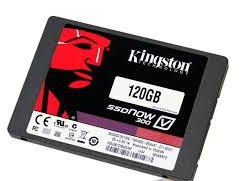
We also replaced a spinning hard drive in a computer that is always on with a solid state drive (SSD).
The spinning drive takes approx 10 watts when in use or idling. The SSD takes approx 0.2 watts.
The computer logs data 24/365 so in total that drive would use 10watts*24*365=87.6watthour=0.09kwh in a year.
That would cost $1927/kwh*0.09kwh= approx $173/year
In addition we have been slowly replacing compact fluorescent bulbs around the house with LED bulbs. A couple of reasons for this. The old CF often take a lot of time (1-2 minutes) to come up to full brightness. They also put out Radio Frequency Interference… a bad thing for our radio telescopes and SID systems.
The LED bulbs also use less power than the CFs.
One day we will put the killawatt meter on both and calculate out the differences.
The last big idea is to replace some of these data logging computers (that still take approx 50w) with smaller more energy efficient raspberry pi systems (maybe 2 watts).
50w/hour=0.05kwh/hour * 24 hours * 365 = 438 kwh/year * average price of $0.22 kwh = $1927*0.4= $423 per year
widespread power outage oct 27th 2015
Yay! The day before the remnants of Hurricane Patricia (from down Puerto Vallarta Mexico way) were scheduled to run over us, the city of Kingston Ontario and the surrounding area, was hit by a widespread power outage, caused by a failure at one of the major transformer stations.
Our part of the city was down from 09:24 to 09:54, just as the cogeneration plant on campus was about to fire up, but it seems it never did. Outside of the city, at home, the power was just fine.. until just after 13:20… where it seems power was diverted into the city.. leaving us high and dry until around 21:00.
The freezers and fridges survived without issue, as did we, as we have cats.
A good supply of battery powered lighting actually worked, although one unit does need new batteries. Food was prepared on the barbeque and that worked well. We had some bottled water (large containers) acting as a thermal mass in the cold room (to help prevent large temperature fluctuations) and ended up using that for various purposes through the evening.
After the first few Estimated Time of Repairs went by, we fired up some alternative power to run the wood pellet stove and a little more lighting. More ETRs went by and we called it a day, turning off anything that might come on again later when power would eventually be restored.
All in all a good training experience.. We now have a list of items to act on to make the next one (possibly even today!) better and smoother and safer.
In the meantime, allsky1 is *down*, radiojove is *down*, sid2 is *down* and in all likelihood will remain so until the weather clears late Thursday.
Ontario – coal free! since 2014 April 15th
Ontario has become the first jurisdiction in North America to fully eliminate coal as a source of electricity generation. The Thunder Bay Generating Station, Ontario’s final remaining coal-fired facility, has burned its last supply of coal and will be converted to burn biomass.
Yay!
Now we just have to get the US states upwind of us to shut down theirs as well and maybe we will all live a little healthier.
On the other hand, electricity prices are heading up again effective 2014 May 01
The New Low Rate — 7.5 cents kW/h, up 0.3 cents — in the overnight weekday hours of 7 p.m. to 7 a.m. and on all weekends and holidays.
The Medium Rate – weekdays between 7-11 a.m. and 5-7 p.m. will be 11.2 cents kW/h, also an increase of 0.3 cents.
The High Rate – 13.5 cents kW/h, weekdays between 11 a.m. and 5 p.m. The on-peak power price is up 0.6 cents kW/h.
Now this is only 50% of the total delivered to your house costs. There are transmission charges, taxes, old debt and other charges as well. Offsetting those is a 10% credit which still tops out the total bill about 2x that of the price of the power alone.
As of today, a 1kwh load running all of the time for one year, will cost you approx $1552 (a little less as I did not take into account statutory holidays). So that 40watt bulb illuminating the cats food and litter area will run you 0.040*$1552 = $62
That old CRT TV that is always plugged in but not turned on is That measured in at 7 watts or $11/year.
Time to start turning off all of the computers when not in use. And a lot of other 110vac powered items!
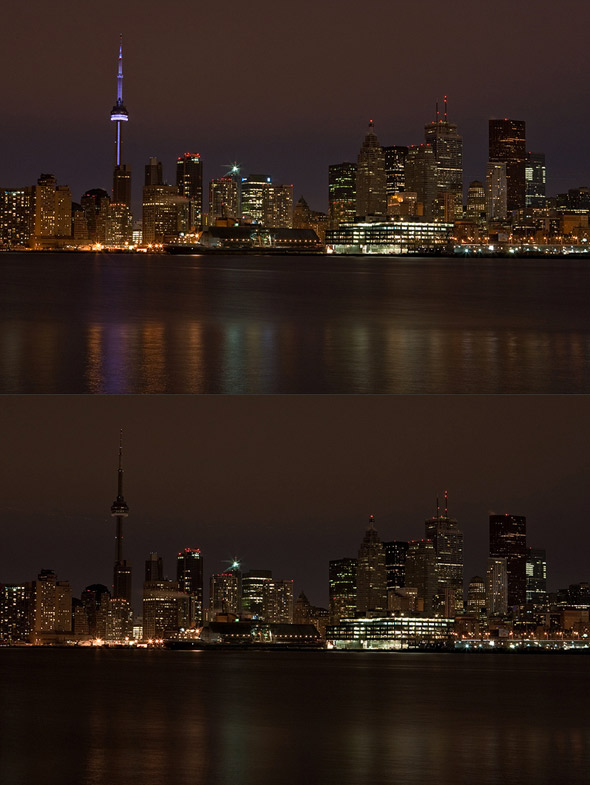
Earth Hour 2013
Last night, Saturday March 23rd, 2013 was Earth Hour, from 20:30-21:30 EDT.
Starting about 10 minutes earlier, we went around shutting off non-essential power, including all lights inside.
We headed out into the darkness outside to do some astronomical observing through the “sucker holes” in the cloud cover. Only about 30-40 minutes into Earth Hour and it clouded up completely.
The next step is to wait for Hydro One’s power usage website to have the data available from last night to see what we actually did hour by hour. Earth hour is offset by 30 minutes from Hydro One’s data, so the impact will not be as dramatic as it would otherwise.
The results are in: we dropped by 320 watt hours or 1/3 kwh for the time, saving approx $0.02 in electricity use (not counting the other $0.02 in transport and loss and debt costs).
The problem is, we can turn off small lights and appliances here and there, but if the freezer or fridge or portable heater kicks in, they obilterate any small savings you may have had otherwise.
This is similar to the daylight savings issue… move the time to save power in lighting but do not count the computers, air conditioning, etc.etc. Let me repeat again.. Daylight Saving is bogus and has no net benefits to Ontarian or Canadian Society.
Remember.. this is just a start… an awareness campaign to make everyone sit down and think… you know.. we really don’t need that outside light on all night. It would be better on a timer to use it only when we need it.. or even a motion detector.. that is far better. Do you really need 100watt equivalent light sources outside that cause glare and deep shadows? Try much lower light levels and you will be surprised at how well you can see more detail in the darkened areas and also be able to see into previously shadowed areas.
This was our 13th annual Fall’N’Stars Star Party (including the inaugural DSNOS). We’ve been at the Boy Scout Camp Sagonaska for 12 years now.
The Event started on Friday September 14th, 2012 at noon, when we opened up the camp and got our own camping gear setup.
We were expecting an early thunderstorm that afternoon and it did finally show up. Lots of rain and wind but it died off and went away in the mid-evening. We actually got some observing done Friday night.
Late evening the Meade DS2090 azimuth drive system started making bad and loud noises, so we shut that down for the rest of the night.
The night was cold and damp with heavy dew and most packed it in early, what with it being a long day.
Saturday morning saw cold and humidity and a lot of socializing by the 30 people that eventually drifted in.
We took apart our Meade DS2090 drive and discovered worn nylon gears in the drive train. Great. No telescope tonight.
In addition the deep cycle lead acid battery we were using for dew heating, died during Friday’s run. It was 8 years old so not too much of a surprise, just a disappointment. So we ran a long 12vdc power extension cable from the van for the night.
A swap meet was held and a few items went here and there. We picked up a lunar meteorite and a martian meteorite for our personal collections and a lunar meteorite for the centre collection.
The afternoon talks started a little late, no problem! and finished early enough for another break, then the group photo.
Mark Coady, myself and Rose Marie Burke gave 20 minute talks on Light pollution, SCO 2011-2012 and barn door trackers, respectively.
The caterers arrived on time at 5pm with another great meal in the longhouse. I really like the fact that they bring their own plates and utensils. In the olden days we spent a lot of time washing up afterward.
After dinner we went into the photo contest prizes, congrats to Rose Marie Burke! Then to raffle prizes. Congrats to Susan Gagnon, winning her 2nd telescope in as many years! Lastly the door prizes… contributed by many attendees and commercial vendors.
We had so many we had to go around twice.
A quick nap and we were ready to start observing for the evening. Kim was checking off her Exploring the Universe Certificate requirements while I was experimenting with the new ultralong exposure capability provided by a new version of CHDK software for the canon powershot A540 camera.
It got cold that night as well.. down to 3 deg C. The next morning was foggy and once the sun came up was actually reasonable to pack up in. At least we did not have to pack up in the rain.
We headed out around 11am as we had commitments back at home for 1. It was a nice 60 minute drive back home. And another two hours unpacking. phew!
Next year. No telescopes and accessories. Just binoculars we think.
Each telescope took up a lot of room including an accessory box, a large battery/power system, an observing table, ground carpet and more.
The skies are not quite as good as we get at home, and we have the advantage of a fully setup observatory to work from.
Modifications need to be made on our 20cm dobsonian scope “Starbuck”, namely adding in better dew heaters in the Telrad finder, adding heaters to the secondary mirror and maybe to the primary mirror as well, or maybe just a fan.
The 2mx2m carpet worked out quite well. Dropped items were quickly and easily found. And no one tripped over power cords.
The Kingston Centre has the lead for Fall’N’Stars 2013 and the first order of business will be to set up an organizing committee and set a date.
New moon is Thursday September 5th. Friday-Sunday Sept 6-8 looks like a good candidate.
One of the chores associated with a wood stove is the annual (2012) sweeping of the chimney. It’s not a bad job but it does leave you coated in a black film of soot.
It takes more time to find the sweep then it does to do the actual job.
In the end we had a few inches of soot.
GLOBE at Night: encourages citizen-scientists worldwide to record the brightness of the night sky. During 2 weeks of moonless evenings, children and adults match the appearance of a constellation (Leo in the northern hemisphere and Crux or Leo in the southern hemisphere) with 7 star charts of progressively fainter stars found at globeatnight.org. They then submit their choice of star chart on-line with their date, time and location to help create a light pollution map worldwide.
Earth Hour 2011
Go Beyond the HOUR!
Saturday March 26th, 2011 – 8:30 pm to 9:30 pm
The theme of this year’s Earth Hour is “Go Beyond the Hour”. People around the world are being encouraged to conserve energy during the scheduled Earth Hour and to continue doing it throughout the year. Queen’s University plans to participate in this initiative and is asking students, faculty and staff to do the same.
The university remains committed to reducing its overall energy use and we need your help to accomplish this goal. With a few small changes to your daily routine you too can make a difference.
Physical Plant Services will:
v Turn off all non-essential heating systems;
v Turn off most non-essential lights. Exceptions include emergency lights, which are hard wired and for safety and security will not be turned off. A few buildings on campus that are open late or allow 24-hour access, including Stauffer Library and Goodes Hall will also stay lit.
v Monitor power consumption levels before, during and after Earth Hour.
Do your part at work:
v Switch off lights when leaving a room.
v Switch off computers, monitors, printers, scanners, radios and other equipment when they’re not in use, and before a meeting, lunch or end-of-day.
v Use power bars to eliminate phantom loads.
v Enable the energy saving functions on your computer equipment.
v Dress comfortably for the weather and adjust your layers before adjusting the thermostat.
Do your part at home:
v Lower the set point of your thermostat.
v Use low-flow plumbing fixtures.
v Open curtains to allow for maximum sunlight in the winter and close the curtains to keep out the sunlight in the summer.
v Take advantage of energy incentives like the current saveONenergy program.
v Celebrate Earth Hour in downtown Kingston at Springer Market Square for the 4th annual “Kingston Unplugged” concert.
Turn Off Your Lights For Earth Hour
8:30 P.M. TO 9:30 P.M. SATURDAY, MARCH 26, 2011
Kingston will participate in Earth Hour in 2011. Between 8:30 p.m. and 9:30 p.m. on Saturday, March 26, lights will go off around the world to mark Earth Hour — a global event to acknowledge humanity’s impact on climate change.
Always a good idea to prep for a star party… in advance!
Case in point, Fall’N’Stars 2010
Last year, you may remember, we took the Centre’s portable power pack (the big one on wheels) to use on the Douglas telescope and it failed miserably dew wise. We opened it up to discover that 3 of the cells inside had ruptured and had leaked and basically we wrote off the 7 year old unit.
This year, the last item that I packed was a car-sized deep
cycle/rechargable Nautilus battery.
We hook up the dew gear on our 20cm dob and none of the lights on the controller come on. Hmm. another bad controller? (We had out Kendrick controller die a couple of years back).
After a lot of wiggling wires, we gave up on the battery and hooked into the vehicle power. That worked! lights, power and heat on the eyepiece.
Back home I took that large battery. hmm read only 3 volts DC. Hook it up to the trickle charger. Nothing… the charger says there is nothing there.
Hook it up to the regular large battery charger. hmmm no current
flowing.
So I opened up the battery lids.. Hmmm. looks pretty dry. 4 litres of
distilled water later the charger started working.
Yay! It starts to bubble as hydrogen gas is produced as a charging
byproduct?
A few hours later I find a large puddle of water on the battery, in the
box and leaked out onto the table…
hmmm not water.. sulphuric acid!
A box of baking soda later, the acid is neutralized and the battery
rinsed off and taking a break until I find a better charging location.
But the battery is now reading over 12vdc!
The moral of the story… better prep work (and battery maintenance!)
will make your observing session a better experience.
A Visit to Wolfe Island
We haven’t been over to Wolfe Island in months, but finally had the opportunity earlier this week.
Our primary reason was to go and visit some gardens.. some very nice large gardens… on the order of acres large.
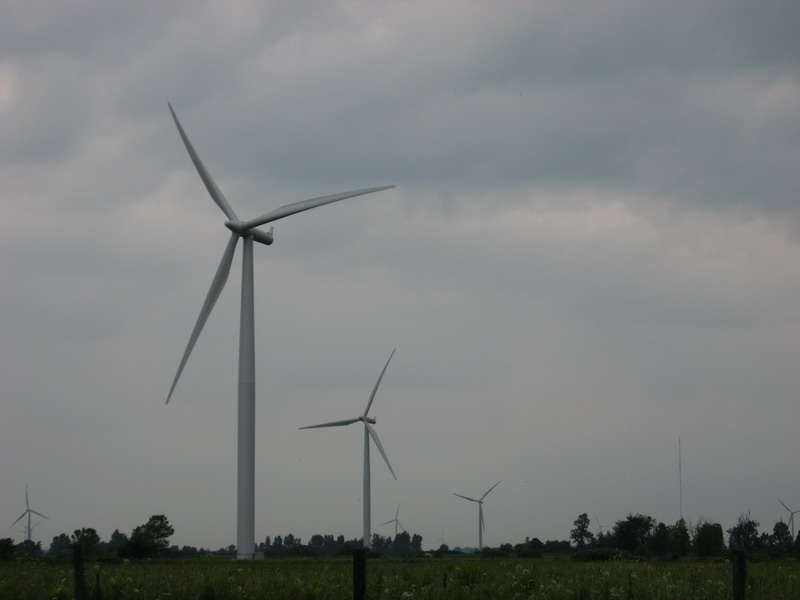
The other big draw was the completed 86 turbine Wolfe Island Wind Farm. We were passing through some thunderstorms and the turbines were spinning!

The are amazing! Very quiet as well… just the minimal noise of the whine of the turbines. You can see their almost realtime power output at
http://www.sygration.com/